
SmartScape: Sensing Dublin Through Its Fibre-Optic Veins
Dublin is a city under pressure. As the city grows, it faces mounting challenges in managing transport congestion, construction impacts, ageing underground infrastructure and environmental sustainability. From the perspective of a local authority, meeting these challenges requires high-resolution, real-time and actionable data on how the city functions at both surface and subsurface levels. This allows the effective monitoring and management of traffic and rail flows in the city as well as the identification of urban infrastructure upgrade and repair requirements. Yet current monitoring methods including camera networks, satellite imaging and city sensors remain constrained by data silos, privacy concerns, and prohibitive operational costs. SmartScape proposes a fundamentally different approach, transforming already deployed publicly owned optical fibre into a city-wide sensor.
This talk will present results from the ongoing SmartScape, an innovative centre-to-centre project comprising The CONNECT and iCRAG research centres alongside key partners Dublin City Council (DCC) and Asiera. SmartScape is transforming DCC’s existing telecoms fibre-optic network into a city-wide sensing platform using Distributed Acoustic Sensing (DAS). By connecting a DAS interrogator unit to two dark fibre rings owned by DCC, we are generating up to tens of thousands of virtual sensors across the city, with down to metre-scale resolution and continuous data capture.
DAS works by sending laser pulses down a fibre and analysing the backscattered light for tiny changes in strain. Vehicles, trams, water displacement and even footsteps leave a detectable signature that be sensed using an optical fibre allowing the generation of data-sets which can ultimately aid local authority planning decisions. What makes the SmartScape project distinctive is the use of advanced optical fibre sensing techniques over Dublin’s public infrastructure as a new smart and sustainable city technology.
In this talk, I will introduce the concept of optical sensing, illustrating the operation of DAS systems over conventional fibre networks, highlighting the advantages and constraints of the technique. I will walk through the motivations for optical sensing in an urban context and local authority data requirements for smart city management. I will show spatiotemporal maps of Seismic Source Power derived from beamforming and seismic interferometry, revealing Dublin's daily and weekly activity rhythms in striking detail. I will present results from controlled validation experiments tracking LUAS trams and ascertaining buried duct infrastructure health, alongside other key findings from large data-sets obtained during several DAS deployments by teams at the Dublin Institute of Advanced Studies (DIAS) and Trinity College Dublin (TCD) over two DCC dark fibre rings.
For an audience at the Asiera conference 2026, SmartScape offers a demonstration of what becomes possible when existing fibre infrastructure used for applications other than standard communications. The same networks that are operated daily for connectivity can, in effect, be transformed into a dense sensing platforms with no new cables, no new civil works and no new right-of-way negotiations. SmartScape brings together a uniquely Irish coalition of seismologists, optical networking engineers and a city authority, and represents a truly interdisciplinary approach to tackling Dublin’s urban challenges.
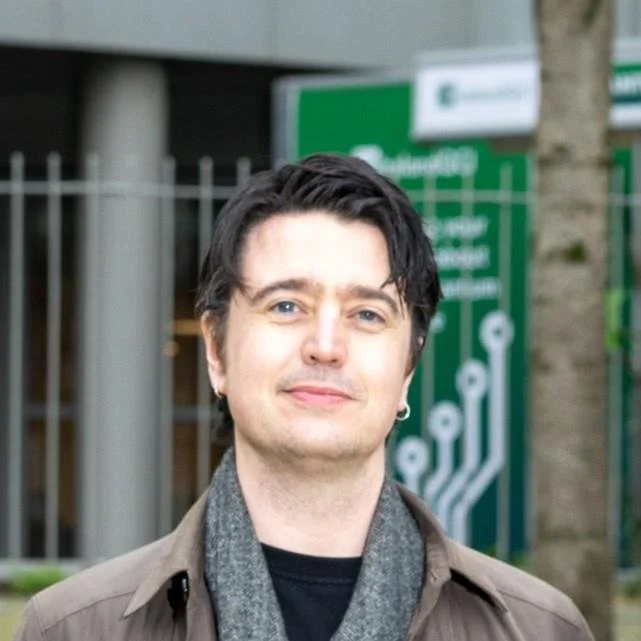
Colm Browning
Smart Docklands
Back to Programme
THURSDAY